I am not generally adding the family trees of the female branches as it will make everything so unwieldy but I feel I should add the Strachan family as that contains our one very interesting person.
1ST GENERATION
JOHN STRACHAN & CHRISTINE BLENSHELL
John was born about 1720 in Aberdeen, Scotland and he married Christine Blenshell who gave birth to the only child of theirs that I have found is
John born about 1743 in Aberdeen
2ND GENERATION
JOHN STRACHAN & Elizabeth findlayson
John born about 1743 married Elizabeth Findlayson on 13 June 1768 and died in May 1794. Elizabeth was born about 1747. John was working in a slate quarry and when blasting a piece of slate went in his eye causing his death some days later. John and Elizabeth had six children but I have only been able to find the following five:
1/ Rachel Strachan born in 1771 in Aberdeen who married Daniel Jamieson on 25th August 1803 in Aberdeen
2/ Margaret born in 1769
3/ James baptised on 11th June 1773 and who died on 27 April 1852 in Aberdeen. James was a bookbinder in Aberdeen
4/ William born in 1775
5/ John in 1778 who went to Canada and married Anne Wood there.
The following information is taken from Wikipedia:
Born 12 April 1778, Strachan was the youngest of six children born to the overseer of a granite quarry in Aberdeen, Scotland. He graduated from King’s College, Aberdeen, in 1797. After his father died in an accident in 1794, Strachan tutored students and taught school to finance his own education.[2]
He emigrated to Kingston, Upper Canada, to tutor the children of Richard Cartwright. He applied to the pulpit of a Presbyterian church in Montreal but did not receive the position. He then became an Anglican minister and became a minister for a church in Cornwall, Ontario.[4]
Strachan taught at a grammar school which was attended by the Upper Canadian elite.[5] He married Ann McGill née Wood, widow of Andrew McGill, in 1807.[6] Together they had nine children, some of whom died young.
He moved to York, Upper Canada, just before the War of 1812, where he became rector of St. James’ Church (which would later become his cathedral) and headmaster of the Home District Grammar School.[3] This school, also known as “The Blue School,” taught students from five to seventeen and emphasized a practical means of learning. Students recited abridged speeches from the House of Commons, learned Latin, and were encouraged to ask questions of their fellow pupils.[7]
Strachan built his home in a large yard bound by Simcoe Street, York Street, and Front Street. It was a two-storey building that was the first building in Toronto to use locally manufactured bricks. The gardens and grounds of the property occupied the entire square and became a local Toronto landmark, being given the name “The Bishop’s Palace”. After Strachan’s death, the home was converted into a private hotel called The Palace Boarding House.
I used to stay at the Lord Simco Hotel when flying with BOAC and think it must have been close to the home John built. Sadly I knew nothing about him in those days or I would have visited the University he founded.
In December 1812, Strachan founded the Loyal and Patriotic Society of Upper Canada which raised £21,500 to support the families of militiaman and care for the wounded.[9] During the Battle of York in 1813, along with senior militia officers, Strachan negotiated the surrender of the city with American general Henry Dearborn. The Americans violated the terms by looting homes and churches and locked the wounded British soldiers and Upper Canada militiamen into a hospital without food or water for two days.[10] Strachan went to meet to complain in person to Dearborn about the violation of the terms of surrender and shamed Dearborn into imposing order on his troops.[11] He is credited with saving the city from American troops, eager to loot and burn it.
After the sack of York, Strachan sent his wife Anne and their children to Cornwall because he believed they would be safe there.[12] A few months later, Cornwall was taken by the Americans, who looted the Strachan home and likely raped a then-pregnant Anne Strachan.[12]
In 1839, he was consecrated the first Anglican bishop of Toronto alongside Aubrey Spencer, He founded Trinity College in 1851 after King’s College was secularized as the University of Toronto.
Strachan died on 1 November 1867 in Toronto. His funeral procession took place on November 5, and wound through the city streets from his home at Front and York to St. James Cathedral.[24]
A plaque at the University of Toronto erected by the Ontario Archaeological and Historic Sites Board commemorates the residence of Strachan. The Bishop’s Palace is the site where assembled the Loyalist forces that defeated William Lyon Mackenzie during the Rebellion of 1837.
In the summer of 2004, a bust of John Strachan was erected in the quadrangle of Trinity College at the University of Toronto. Strachan Avenue, running from the original site of Trinity College to Lake Shore Blvd., is also named in his honour.
I found this photo on the web and obviously he had a great send off

A friend went to Toronto and kindly took the last three of these photos for me.


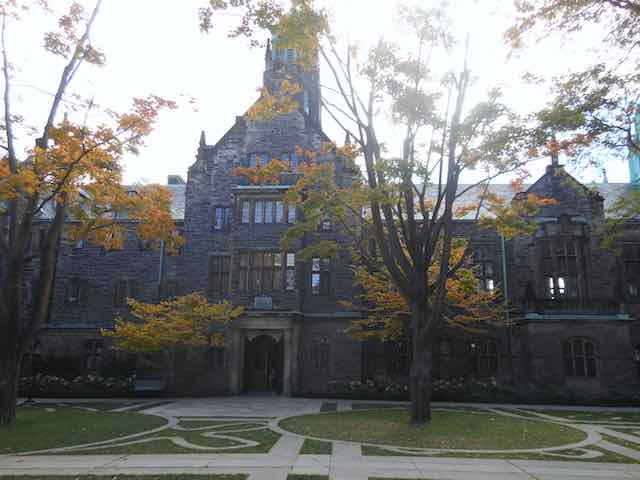
I wish I had known about John Strachan before I married as I used to go to Toronto so often. When there I stayed at the Lord Simco Hotel which I understand was across the road from Simco House where I understand that he lived for some time.